

The remembAR project was created during the “Smart Home Internship” course as part of my Master's degree. In a group of 14 people, divided into a conception and a development team, the aim was to get creative and develop a scenario in which AR glasses and smart home objects make everyday life easier for users. Together, we developed the first use cases and scenarios for remembAR: the application should show users which important items have been forgotten when they leave their home. On this page, I will present the project and focus on my input for the team.
The Concept
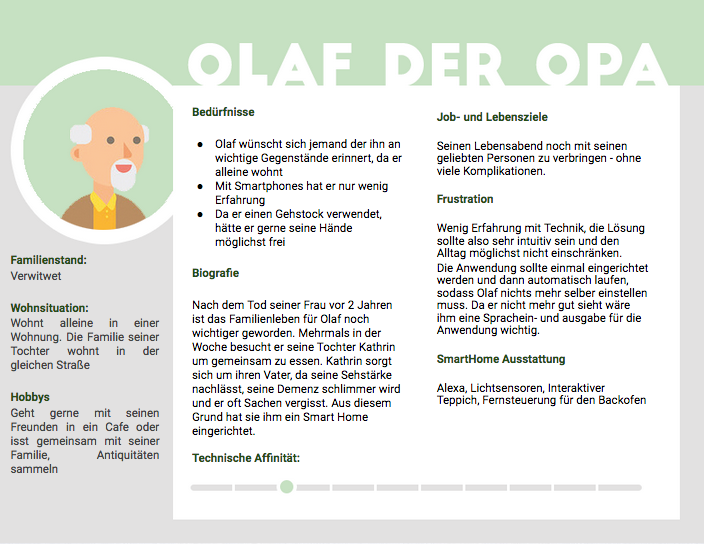
The first step for the project was personas. The task of these was to better empathize with our target group. One of the three users chosen was Olaf the grandpa. Of course, it's not always easy to remember everything, and dementia and Alzheimer's can also occur with increasing age. At the same time, interfaces need to be simple and easy to use so that older people with lower media skills in particular can quickly find their way around and enjoy using them. With our persona, we wanted to try to tailor our application to the needs of our users.
The Smart Home Lab also provided us with two AR glasses for our project: The Epson Moverio and the HoloLens were connected to smart home elements and beacons on objects were used to check whether they were still in the house or not. An interaction concept with a use case was created to provide a better overview of how the individual components relate to the user:
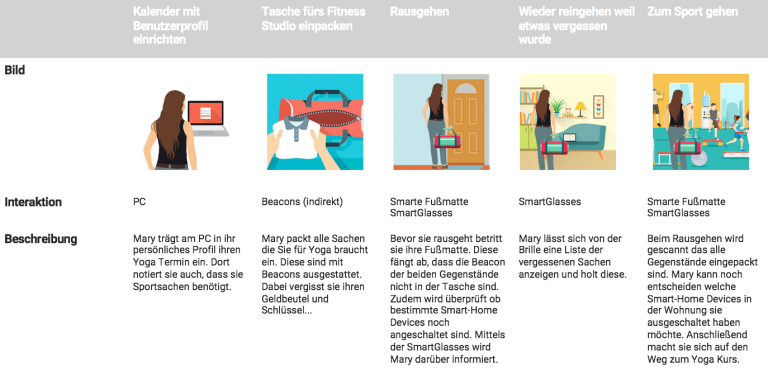
By combining a smart doormat, the beacons, setting up appointments with required items and the AR glasses, our application can guarantee that the user will no longer forget any items at home in the future.
Logo and App Icon
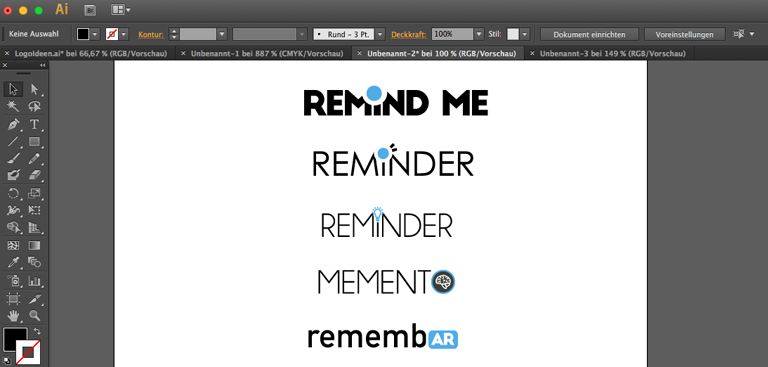
Once the initial ideas had been documented and the first mock-ups for the AR glasses had been created, the next step was to give our idea a recognition value. By creating several drafts of the logo and the application name, the team agreed on the name remembAR - a fitting name for our AR application that reminds users of forgotten objects.
The User Test
Once the first prototype for both pairs of glasses had been created, it was time for testing: with 6 participants between the ages of 21 and 42, we tested our concept for user-friendliness and comprehensibility and also wanted to find out how the two AR glasses were easy to use and comfortable to wear. In an initial interview, we gathered information about the test subjects' media usage. Then the AR glasses were tested: the test subjects were given 2 scenarios in which objects were forgotten by means of simple tasks. By asking questions about the interface, the comprehensibility of the icons and gestures and the thinking-aloud method, we were able to gather a lot of feedback about the concept. This was followed by another interview, which focused on AR glasses and visions for the future.
Lessons Learned
Many new insights were gained from the project. Firstly, how to set up a user test in which two pairs of glasses were compared and how to create the necessary documentation (e.g. data protection documents). Although our idea was well received, the acceptance of AR glasses is not yet very high, as they are not really comfortable and are very uncomfortable to wear after a while. The use of gesture control is also somewhat unfamiliar at first.
However, the biggest learning factor was working with AR glasses, as this opens up new possibilities for the user experience and you should pay attention to a minimalist and clear screen design.
 English
  German