

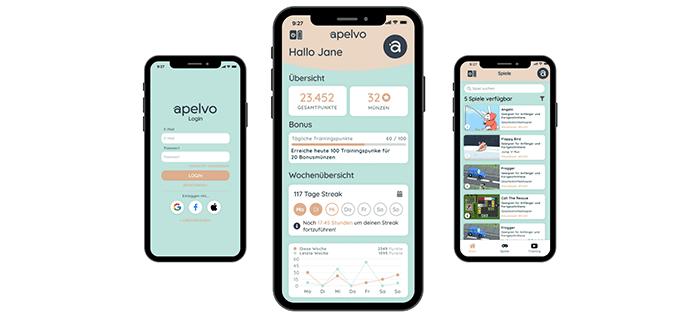
Apelvo - Gamified Pelvic Floor Training
Apelvo is an innovative app that enables playful pelvic floor training. With the help of a sensor that is attached to the skin and measures the activity of the pelvic floor muscles, users can control elements in various games. This app is being developed by fysor GmbH and is part of a funding project by Stuttgart Media University in collaboration with the company Lab132. The funding project runs until December 2024.
Target Group Research
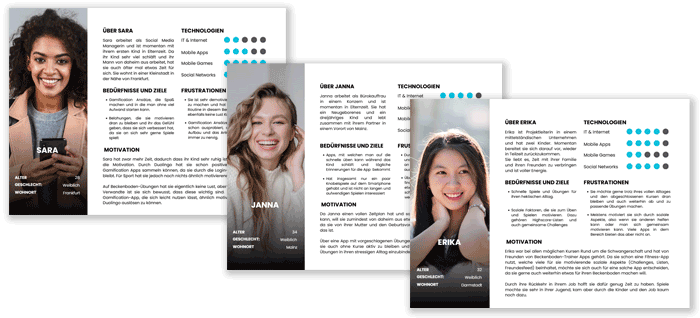
Apelvo is primarily aimed at women between the ages of 20 and 40, especially those who are about to become pregnant or have recently become pregnant. This target group often needs targeted pelvic floor training to support their physical health in the long term. Apelvo aims to offer a solution that is not only functional, but also promotes user motivation and engagement through gamification and user-centered design.
Project Management
In order to better understand the needs and preferences of the target group, we first created personas and also conducted a detailed target group survey. The focus was on the following questions: What games does the target group play? Which fitness and gaming apps do they use? Does the target group already have experience with pelvic floor training and how open would they be to a gamified solution?
Based on these findings, we organized a game design workshop. In a group of four people, we developed ideas for games that are fun in the long term and can be implemented efficiently. Two game concepts stood out in particular: a game in which you control a jet of water to extinguish a fire and another in which you control a cat's jumps to overcome obstacles. All game ideas were documented and form the basis for future developments.
Design and Prototyping
In the next step, my focus was on deriving an interaction concept from the data collected in the target group analysis. I analyzed the expectations and usage patterns of users in the area of fitness and gaming apps. With these findings, I created an intuitive and user-friendly interface that is tailored to the specific requirements of the target group.
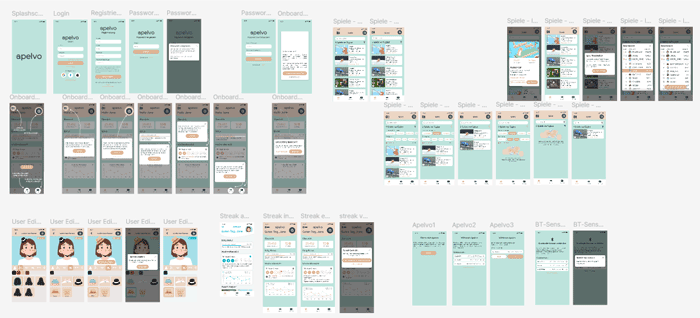
The design process followed an iterative approach: First, I created a low-fidelity wireframe to sketch out the basic layout and information architecture of the app. I then developed a clickable high-fidelity prototype in Figma that was not only visually appealing, but also accurately depicted interaction patterns and micro-interactions. This prototype allowed the developers to use pixel-perfect specifications for implementation and ensure a user-centered development process.
Usability Study
After the initial implementation of the games and the app components, we conducted a usability study with six test subjects to validate the user-friendliness and the gaming experience. Both qualitative and quantitative data was collected in order to gain well-founded insights into the usability of the app. The test subjects were guided through a series of predefined tasks while their interactions and reactions were observed and documented.
The feedback from the tests was overwhelmingly positive: participants praised the unique combination of training and gameplay and found the controls intuitive and motivating. At the same time, we identified some usability issues via a problem index, which were fixed in future iterations to further optimize accessibility and the user experience. This data-driven evaluation helped to further tailor the product to the needs of the target group and continuously improve the user experience.
Current status (October 2024)
The app is currently in the App Store and the first satisfied customers are already using it for their pelvic floor training. New games are being planned and the user interface is being further optimized to adapt the app to the Figma designs. A further study in the area of game design is planned, which I will report on soon.
 English
  German